In the previous article, we looked at why retail is different in the SAP context.
Retail processes are close to the competitive position of the company. They are high-volume, time-sensitive and often already heavily automated. The remaining manual work is therefore not simply untouched work waiting to be automated. It often exists because ambiguity, variance, responsibility or cost made deterministic automation difficult.
This is where AI becomes interesting.
We see AI-augmentation of employees as the default use case for AI in many companies.
Employees should be able to use AI tools to access information, analyze data, summarize documents, compare options and prepare decisions, within the limits of their authorization and the company’s data protection rules. With MCP servers or similar technologies, this may include access to business software, documentation, transactional data and master data.
In this form, AI remains a tool in the hands of the employee. The initiative remains with the human. The responsibility remains with the human.
The line is crossed when AI becomes proactive or process-bound.
If an AI system observes a process, generates recommendations automatically, routes cases, drafts decisions for approval or triggers follow-up activities, it has become part of the business process. Even if a human still clicks approve, this is no longer augmentation, but AI- automation.
For retailers, we see the following options when wanting to improve a process:
1) Further augmentation: The first option is further augmentation. AI supports the human decision, while the decision itself remains with a person. On the user’s request, it collects context, compares similar cases, highlights deviations, prepares explanations and suggests options. Further augmentation may mean giving the user easier access to additional information.
2) Classic automation: The second option is to disambiguate the process, and then automate it deterministically. AI may help analyze documentation, past decisions, tickets, custom code, user explanations and process variants in order to achieve this, compare the chapter on tactical IT.
3) AI-automation: The third option is AI-based automation. In this case, the AI system becomes part of the automated decision itself. This may be useful where deterministic automation is not practical, because the inputs are too varied, the language too ambiguous, or the number of possible situations too large to define upfront.
The decision process should be as follows
First, the organization should ask whether the current restrictions and manual checks are still necessary and desired. Some manual work exists because a process was never cleaned up. Some exists because responsibilities are unclear. Some exists because an old restriction no longer makes sense.
Second, the organization should look at economic relevance. How often does the process occur? How much effort does it consume? What value would better speed, quality or consistency create?
Third, when the first steps have been passed, the organization should decide between deterministic automation, further augmentation and AI-based automation.
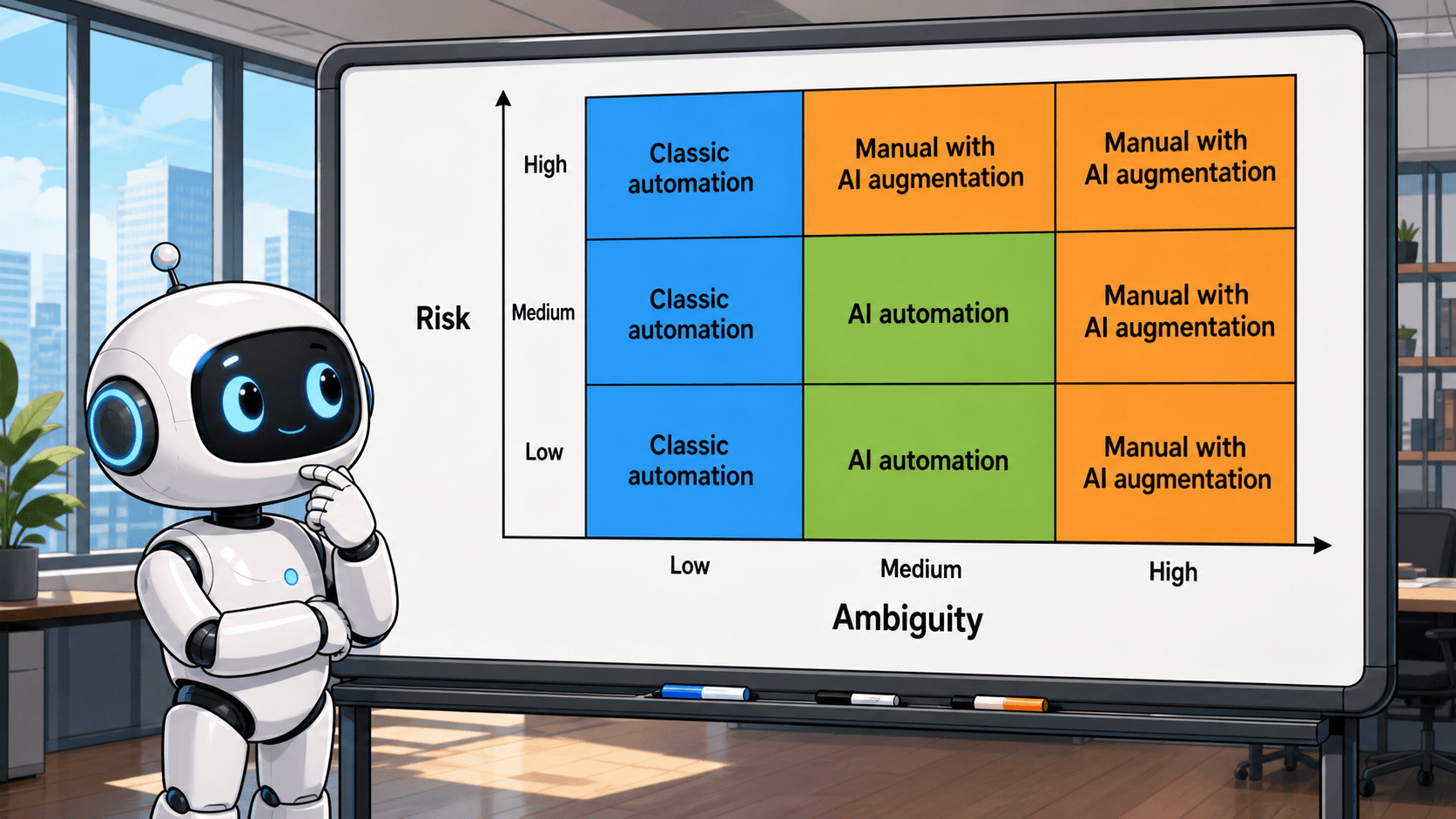
• If ambiguity of the decision criteria is low and the decision criteria are also stable, deterministic automation will often be the right answer.
• If ambiguity is medium or high and the risk of a wrong decision is significant, AI-supported human work will often be the better answer.
• If ambiguity is medium, risk is low, the decision can be reversed, and deterministic automation is not practical, AI-based automation may be acceptable. Even then, it needs clear guardrails, logging, escalation paths, test cases, monitoring and a realistic view of recurring AI costs. It will generally neither be the cheapest nor the easiest option.
Non-reversibility increases risk. A wrong decision that can easily be reversed is different from a wrong decision that immediately affects prices, customers, vendors, stock levels or legal obligations.
This is especially important in retail because many decisions are not dramatic individually. They become important through volume. A wrong price, a wrong listing, a wrong replenishment proposal, a wrong vendor condition or a wrong article master data decision may look small in one case, but become significant when multiplied by many articles, stores or customers.
The arrival of agentic AI tools will make this more difficult. Employees will be able to build small tools, workflows, reports and automations much more easily than before. Some of this will be useful. Some of it will create risks the builder does not fully understand: wrong data access, unclear responsibility, hidden process changes, untested assumptions and recurring AI costs.
Automation and AI-based automation should therefore go through formal decision processes and be treated as change requests. General augmentation can be made broadly available, if access rights, confidentiality and usage rules are clear. Process-bound AI needs stronger governance.
As in the other layers we have discussed, AI is most useful when it helps humans understand faster and decide better.
It becomes dangerous when ambiguity is handed over to the system without enough clarity on responsibility, process goals and consequences.
What acceletail offers:
We help retailers identify where AI can support SAP processes sensibly: as a general tool for employees, as support for consultants and process experts, as a way to disambiguate manual work, and where appropriate, as part of controlled automation. With accelet.ai, we can connect documentation, SAP context, custom code and process knowledge to help make these decisions with better information.
What acceletail offers
If you want to discuss AI in SAP Retail, maintenance, projects or business processes, we are happy to start with a first conversation.
Get in touch